
How to Spin Straw into Gold & Unlock Proposal-Ready Content


Content is the lifeblood of every winning GovCon proposal, yet it is often the weakest link in the process. Proposal managers routinely receive last-minute input that sounds polished but lacks strengths, proof, and alignment with evaluation criteria. In other cases, SMEs submit dense technical narratives written for peers rather than evaluators. Either way, proposal teams are expected to spin straw into gold, transforming vague or overly technical content into compliant, high-scoring proposal-ready content.
When capture managers, SMEs, executives, and subcontractors are not aligned around evaluation criteria, the result is predictable. Fire drills escalate. Collaboration becomes strained. Win probability suffers. This is not simply a writing challenge; it’s a structural alignment issue. When alignment is intentional and evaluation-driven from the start, proposal-ready content becomes far easier to produce and far more likely to win.
What to Do When You Get Pushback
The team’s first response is usually to push back. Proposal managers often encounter resistance when asking for revisions or stronger alignment. Common responses include:
- “This is how we always write it.”
- “The evaluators are technical. They’ll understand.”
- “We don’t have time to restructure this.”
- “The content already sounds good.”
When pushbacks occur, shift the discussion away from writing style and toward evaluation scoring: anchor the conversation in Section M, and ask where the explicit strength is stated and how the content reduces risk in the evaluator’s view. Framing the issue around the proposal score rather than preference changes the dynamic.
Data also helps. If past debriefs cited weaknesses, lack of clarity, or insufficient differentiation, use that evidence to reinforce the need for structured proposal management—executives respond to win rate impact. In competitive pursuits, misaligned content can lower technical scores even when the solution is strong.
Start Proposal-Ready Content in Capture
Proposal-ready content begins during capture, not kickoff. Strong proposal management requires early coordination between capture managers and proposal teams around evaluation criteria and competitive positioning.
Before the RFP is released, teams should align on likely Section M factors, customer pain points, procurement history, and positioning under relevant NAICS codes or GWACs. Capture managers should define clear strengths that articulate discriminators and customer-focused benefits. A simple framework can dramatically improve content quality:
- What challenge is the agency trying to solve?
- What is our differentiated solution?
- Why is it better than competitors?
- What proof supports this claim?
- What measurable results demonstrate impact?
When capture teams use this structure, they generate strength-based content rather than generic summaries.
Give SMEs a Structured Input Framework
SMEs are technical experts, not proposal designers. Asking for a general narrative often yields dense, technical writing that does not align with evaluation scoring. Instead, provide prompts tied directly to evaluation criteria:
- What specific agency risk does this approach reduce?
- What measurable results have we achieved on similar contracts?
- What makes this solution difficult for competitors to replicate?
- Why would this score higher under Section M?
These questions shift the focus from description to differentiation. When SMEs focus on strengths, benefits, and risk reduction, proposal design improves significantly.
Use AI Strategically
AI is now part of many GovCon proposal management environments. When used strategically, it accelerates drafting. But when used loosely, it generates content that sounds polished but lacks substance. AI-generated content often fails because it lacks evaluation criteria and customer context. If your team uses AI, prompts must include evaluation factors, differentiators, and measurable outcomes.
Conduct Early Alignment Reviews
Don’t wait for a review to identify problems. Short alignment reviews before major draft milestones can prevent schedule pressure and last-minute rewrites. Ask:
- Does this content clearly map to Section M?
- Are strengths explicitly stated?
- Is the benefit measurable and customer-focused?
- Would a non-technical evaluator understand the value?
These checkpoints reinforce disciplined proposal management and reduce rework.
The Bottom Line
High-scoring proposals are built on alignment, not last-minute editing. When capture managers, SMEs, executives, and proposal teams collaborate on evaluation criteria and a strength-based winning approach from the beginning, proposal-ready content becomes the standard rather than the exception.
Lohfeld Consulting helps GovCon organizations improve proposal management processes, strengthen capture-to-proposal integration, and implement Strength-Based Winning® strategies that increase win probability. If you’re ready to reduce fire drills, improve collaboration, and increase technical scores, contact Lohfeld Consulting.
Related Information
By Brenda Crist, Vice President at Lohfeld Consulting Group, MPA, CPP APMP Fellow
Lohfeld Consulting Group has proven results specializing in helping companies create winning captures and proposals. As the premier capture and proposal services consulting firm focused exclusively on government markets, we provide expert assistance to government contractors in Capture Planning and Strategy, Proposal Management and Writing, Capture and Proposal Process and Infrastructure, and Training. In the last 3 years, we’ve supported over 550 proposals winning more than $170B for our clients—including the Top 10 government contractors. Lohfeld Consulting Group is your “go-to” capture and proposal source! Start winning by contacting us at www.lohfeldconsulting.com and join us on LinkedIn, Facebook, and YouTube(TM).
Paperback or Kindle
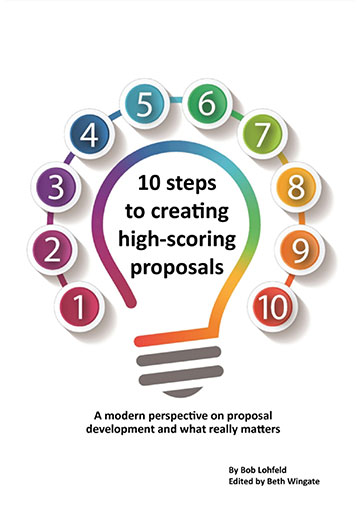
10 steps to creating high-scoring proposals
by Bob Lohfeld
contributors Edited by Beth Wingate

Subscribe to our free ebrief
Teaming friends, frenemies, and enemies—12 tips to mitigate harmful effects
Did you know that contracting officers spend up to 20% of their time mitigating disputes between teaming partners? In an informal poll we conducted on LinkedIn last month, 40% of respondents classified their teaming partners as “frenemies” on their last bid.

Subscribe to our Capture & Proposal Tips eBrief. It’s free!

Sign Up for INSIGHTS and Download your FREE book
We'd love to help you with your proposals. Enjoy our complimentary Lohfeld Consulting Group Capture & Proposal Insights & Tips book with your FREE subscription to our Insights Newsletter.
GET YOUR FREE BOOK