
How to Eliminate Proposal Weaknesses Before Submission


Proposal weaknesses are rarely accidental. In most cases, they are the predictable result of incomplete capture, underdeveloped solutions, or failure to explain execution in measurable terms. Teams that wait until a customer debrief to understand why a weakness was assessed have already lost valuable ground.
The Federal Acquisition Regulation (FAR) defines a weakness as:
“A flaw in the proposal that increases the risk of unsuccessful contract performance.”
This definition establishes the evaluator’s standard. A weakness is not about writing quality or presentation; it’s about whether the proposal provides enough detail to demonstrate that the work can be executed successfully at an acceptable level of risk.
What an Evaluated Weakness Looks Like
The following is a common and preventable example taken from typical evaluation language:
The Offeror proposes working closely with the Government to manage transition activities. However, the proposal does not explain how transition risks will be identified, mitigated, or managed. The lack of a defined transition approach increases the risk of unsuccessful contract performance.
The proposal met the requirement and expressed the correct intent. However, it failed because it did not explain execution. From the evaluator’s perspective, the proposal did not answer basic questions, including:
- Who owns transition risk management?
- What process is used to identify and track risks?
- When are risks reviewed and escalated?
- How are mitigation actions implemented and measured?
- What specific controls reduce the likelihood of transition failure?
- Have you ever implemented this solution successfully on any prior contract?
When proposals omit this level of detail, evaluators document risks that meet the FAR definition of a weakness.
How Weaknesses Appear Across Proposal Volumes
The same pattern that produces transition weaknesses appears throughout proposals. In each case, the proposal states intent but does not demonstrate execution. Table 1 depicts five common examples describing how risks creep into proposals.
Table 1: Five Examples of Weaknesses in Proposals
| Proposal Section | Description of Proposal Weakness |
| Staffing and Key Personnel | The Offeror proposes qualified staff. However, the proposal does not explain how staffing levels were calculated, how vacancies are covered, or how surge requirements are met. |
| Management Approach | The Offeror describes a management structure but does not define decision authority, escalation procedures, or issue-resolution timelines, increasing the risk of ineffective management responses. |
| Technical Approach | The Offeror describes tools and processes, but does not explain how they will be configured for the Government environment, integrated with existing systems, or secured, creating execution uncertainty. |
| Risk Management | The Offeror identifies risks but does not assign ownership, define mitigation actions, or describe monitoring and reporting methods, reducing confidence in effective risk control. |
| Past Performance Relevance | The Offeror provides past performance examples but does not clearly explain how the scope, scale, and complexity relate to the current requirement or how well they performed, which increases uncertainty regarding applicability. |
In each case, the weakness results from missing execution details—not noncompliance.
Why Weaknesses Originate Before Proposal Writing
Most weaknesses are introduced during capture and solution development rather than during proposal drafting. When teams enter proposal kickoff without validated assumptions, defined processes, or measurable approaches. Common causes include:
- Solutions that describe activities without defining methods or outputs
- Unvalidated assumptions about customer priorities or constraints
- Staffing and management models built for flexibility rather than requirements
- Capture strategies that are not translated into executable approaches
Strong writing cannot compensate for an incomplete solution. Proposals reflect the maturity of the underlying plan.
Five Practical Methods to Prevent Proposal Weaknesses
Reducing weaknesses requires disciplined execution throughout the business development lifecycle. The practices listed in Table 2 directly address evaluator risk concerns.
Table 2: Five Practical Methods to Reduce Weaknesses in a Proposal
| Risk Reduction Method | Description |
| Conduct Disciplined Capture | Effective capture produces specific, usable inputs for proposal development, including: • Documented requirements, constraints, and success measures • Validated assumptions with supporting rationale • Identified performance risks and planned controls • Competitive assessment tied to likely evaluation discriminators Capture outputs should enable solution development without guesswork. |
| Validate the Solution Before RFP Release | When access allows, teams should test proposed approaches with the customer to confirm feasibility and relevance. This validation focuses on: Operational practicality of the approachAlignment with customer prioritiesIdentification of technical and management execution risks Solutions that are validated are easier to explain and easier for evaluators to assess as low risk. |
| Analyze the RFP Using Evaluation Criteria | RFP analysis should be structured on proposal evaluation criteria. This includes: A compliance matrix that traces every requirement to proposal contentAn outline aligned to evaluation factors and subfactorsPage allocations based on execution details rather than background information Proposals should allocate as much space as the page limitations allow to explain processes, controls, and performance management backed up with proof points. |
| Connect Execution to Demonstrated Capability | Proposals should explicitly link approaches to proven experience. This requires: Clear mapping between proposed processes and past performance examplesExplanation of how prior results will be replicatedIdentification of systems and personnel who have executed similar work These connections reduce evaluator uncertainty about performance outcomes. |
| Use Visuals to Clarify Execution | Visuals should be used to reinforce understanding of execution, not to decorate the proposal. Effective visuals: Show process flow, decision points, and interfaces Identify responsibility and timing Align directly with narrative descriptions Well-designed visuals reduce ambiguity and enhance evaluator confidence. |
Conclusion
Evaluated weaknesses document uncertainty about execution. That uncertainty is usually avoidable. Lohfeld Consulting supports teams by identifying execution gaps early, strengthening capture discipline, and ensuring proposals demonstrate credible, low-risk performance before submission. If your objective is to submit proposals that withstand evaluator scrutiny, contact Lohfeld Consulting; we can help you achieve it.
Relevant Information
By Brenda Crist, Vice President at Lohfeld Consulting Group, MPA, CPP APMP Fellow
Lohfeld Consulting Group has proven results specializing in helping companies create winning captures and proposals. As the premier capture and proposal services consulting firm focused exclusively on government markets, we provide expert assistance to government contractors in Capture Planning and Strategy, Proposal Management and Writing, Capture and Proposal Process and Infrastructure, and Training. In the last 3 years, we’ve supported over 550 proposals winning more than $170B for our clients—including the Top 10 government contractors. Lohfeld Consulting Group is your “go-to” capture and proposal source! Start winning by contacting us at www.lohfeldconsulting.com and join us on LinkedIn, Facebook, and YouTube(TM).
Paperback or Kindle
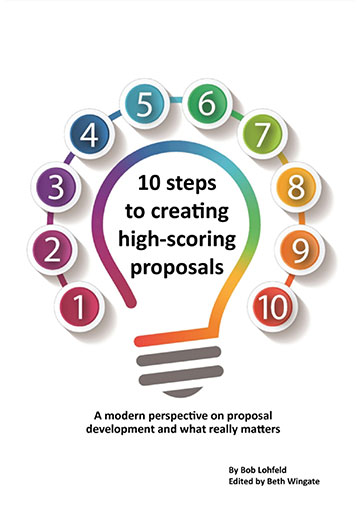
10 steps to creating high-scoring proposals
by Bob Lohfeld
contributors Edited by Beth Wingate

Subscribe to our free ebrief
Teaming friends, frenemies, and enemies—12 tips to mitigate harmful effects
Did you know that contracting officers spend up to 20% of their time mitigating disputes between teaming partners? In an informal poll we conducted on LinkedIn last month, 40% of respondents classified their teaming partners as “frenemies” on their last bid.

Subscribe to our Capture & Proposal Tips eBrief. It’s free!

Sign Up for INSIGHTS and Download your FREE book
We'd love to help you with your proposals. Enjoy our complimentary Lohfeld Consulting Group Capture & Proposal Insights & Tips book with your FREE subscription to our Insights Newsletter.
GET YOUR FREE BOOK