
How to Move from AI Agent Sprawl to AI Maturity


AI agent or prompt sprawl signals a predictable stage of AI maturity, but the next stage is within reach. Speed is a natural first measure for teams adding prompts one task at a time, and it helps explain why so many GovCon teams now run dozens of single-purpose prompts and agents with no shared design behind them.
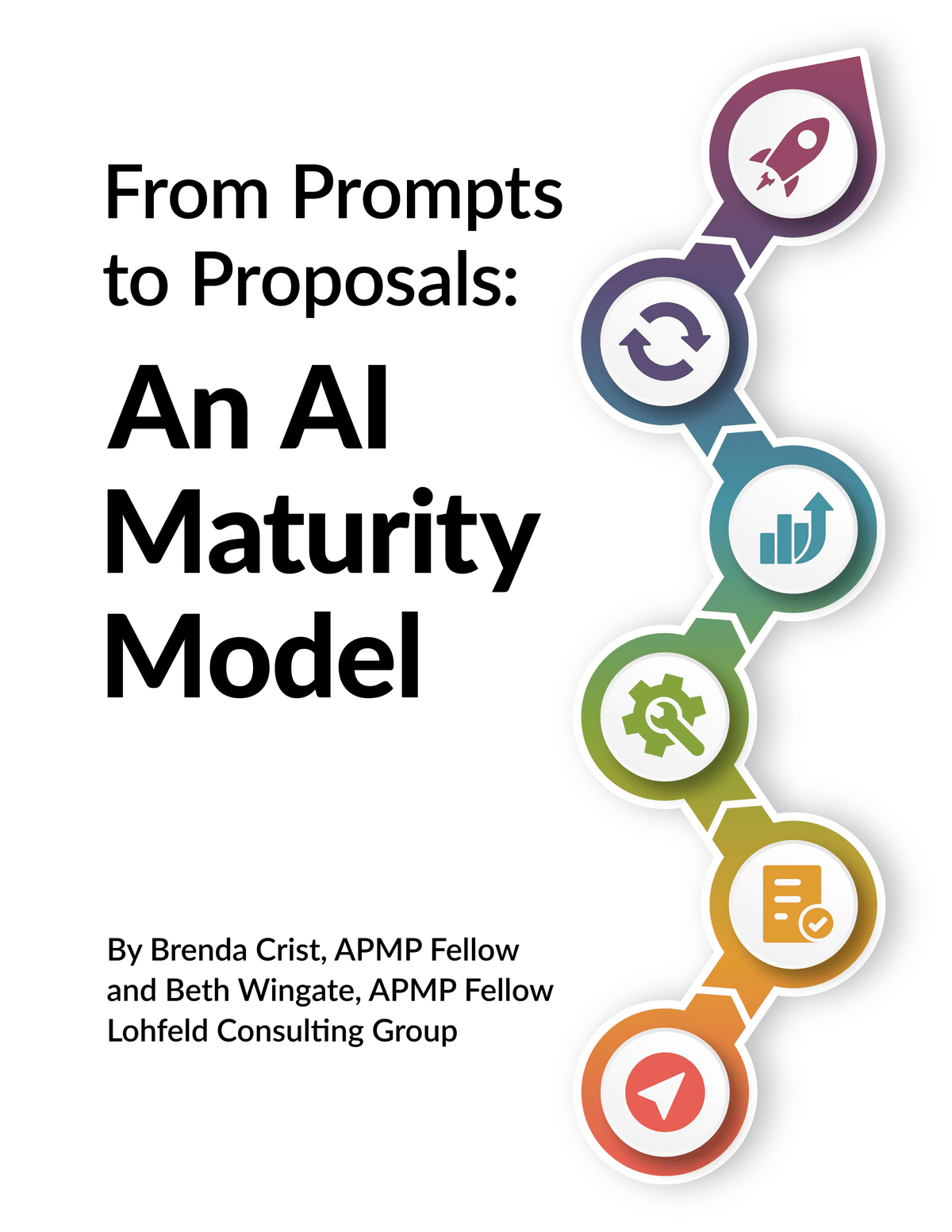
Lohfeld’s previous blog, How to Tame AI Prompt and Agent Sprawl, offers five tips for maintaining the prompts and agents a team already has, while this companion piece looks ahead. Showing what comes after sprawl, our book, From Prompts to Proposals: An AI Maturity Model, describes five levels of AI maturity for bid and proposal teams.
Recognize Your Current Stage of AI Maturity
The Lohfeld AI Maturity Model is a sequencing tool. Each level has a goal and a set of minimum capabilities that must be in place before a team moves up:
- Level 1 – Explore: Individuals experiment on their own, and results depend on the user. The goal is to prove AI is useful and safe enough to try.
- Level 2 – Apply: Teams identify high-value use cases such as RFP analysis, compliance extraction, and first drafts, and they adopt repeatable prompt patterns. The goal is to turn experimentation into repeatable wins.
- Level 3 – Standardize: AI is embedded in defined proposal workflows, supported by a teamwide playbook, content library readiness, and security controls. The goal is consistent output across the team.
- Level 4 – Scale: Teams use AI to raise proposal quality and track cycle time, rework, compliance defects, and strength effectiveness. The goal is to improve quality and competitiveness.
- Level 5 – Transform: AI orchestrates workflows through intake, compliance, drafting, and quality assurance, with defined human approvals at critical points. The goal is for AI to orchestrate work safely while humans steer strategy.
Most proposal organizations operate across several levels at once. Prompt sprawl typically appears at Level 2, when a team has found use cases that work, yet each prompt lives with the person who built it. The book describes this stage plainly: AI use is repeatable but not standardized, and value is visible while outcomes vary.
Signs You’ve Outgrown Ad Hoc Prompting
Teams rarely notice the moment they outgrow ad hoc prompting. Watch for these signals, drawn from the AI Maturity Model:
- Results depend on who runs the prompt. One writer’s AI-assisted draft is excellent, and another’s reads like AI Speak.
- Duplicate prompts multiply. Three capture managers maintain three versions of the same RFP analysis prompt, and no one knows which performs best.
- Reviewers lose confidence. Color review teams spend time questioning AI-assisted content instead of improving it.
- Governance questions surface. Security officers and leadership begin asking which tools touch which data, and the team cannot answer with confidence.
- Time saved is the only measure. Value is easy to claim and hard to defend when no one tracks rework, compliance defects, or evaluator-facing quality.
- Expertise walks out the door. The best prompts leave when the people who wrote them move to another pursuit or another company.
According to the book, “Level 3 is where many organizations struggle and where maturity begins.” Teams that skip it “often experience AI chaos: conflicting outputs, distrust among reviewers, and growing resistance from leadership.” Sprawl left unaddressed leads directly to that outcome.
What Managed and Orchestrated AI Looks Like
Managed AI begins at Level 3, when AI shifts from personal to institutional. Approved prompts, governed content sources, and defined review checkpoints replace individual improvisation. A teamwide playbook explains how AI is used in each proposal phase, and content is organized, named, and tagged so AI retrieves reliable inputs. Guardrails address hallucination, bias, security, and AI Speak.
Level 4 adds measurement and quality control to proposal management. Teams adopt an AI-enabled quality framework, an enforced proposal style guide, a knowledge management program, and key performance indicators tied to proposal outcomes. AI helps clarify strengths, reinforce differentiation, and improve evaluation readiness—the same outcomes Lohfeld’s Strength-Based Winning® methodology targets.
Orchestrated AI arrives at Level 5. Agentic systems carry out multi-step tasks within predefined workflows, rules, and guardrails, while remaining subject to human direction. The book identifies four human approval gates that keep people in control:
- Intake Validation Gate: The proposal manager or capture lead confirms that AI-extracted requirements, outlines, and compliance matrices are correct.
- Compliance Signoff Gate: The compliance lead or proposal manager certifies that all instructions, forms, and mandatory requirements are addressed.
- Final Proposal Readiness Gate: Proposal, solution, and capture leaders decide whether the proposal is ready for formal evaluation.
- Final Submission Gate: An authorized proposal executive approves submission, because AI does not sign off.
Accountability artifacts document each gate, including logged approval checklists, human-reviewed AI output summaries, risk flags with documented disposition, and version histories. At this level of AI maturity, teams stop asking “Did AI produce this?” and start asking, “Was the right human in the loop when this decision was made?”
The Bottom Line
Prompt sprawl is a stage of AI maturity, and teams move past it by standardizing workflows, measuring quality, and placing humans at defined decision points. Each level builds the foundation for the next, and steady progress turns scattered prompts and AI agents into a dependable proposal capability. Download a free copy of From Prompts to Proposals: An AI Maturity Model to assess your current level, and explore training to build the skills each level requires. Contact us to learn how Lohfeld can help your team advance its AI maturity.
Continued Reading
Take the next step toward AI maturity with these Lohfeld resources:
- How Proposal Professionals Measure AI Tool Effectiveness: Most GovCon teams still judge AI by time saved alone. See how 139 capture and proposal professionals measure AI and which measures move teams to higher levels of maturity.
- The Real ROI of AI in Proposals: Reported AI savings dropped sharply between 2024 and 2026. Learn why measurement and verification time is maturing, and what baseline your team should expect.
- How to Build an AI Learning Strategy for GovCon Proposal Teams: Self-study alone produces uneven skills across a proposal team. Discover how to combine self-study, peer learning, and formal training into a roadmap that supports every maturity level.
By Brenda Crist, Vice President at Lohfeld Consulting Group, MPA, CPP APMP Fellow
Lohfeld Consulting Group has proven results specializing in helping companies create winning captures and proposals. As the premier capture and proposal services consulting firm focused exclusively on government markets, we provide expert assistance to government contractors in Capture Planning and Strategy, Proposal Management and Writing, Capture and Proposal Process and Infrastructure, and Training. In the last 3 years, we’ve supported over 550 proposals winning more than $170B for our clients—including the Top 10 government contractors. Lohfeld Consulting Group is your “go-to” capture and proposal source! Start winning by contacting us at www.lohfeldconsulting.com and join us on LinkedIn, Facebook, and YouTube(TM).

Teaming friends, frenemies, and enemies—12 tips to mitigate harmful effects
Did you know that contracting officers spend up to 20% of their time mitigating disputes between teaming partners? In an informal poll we conducted on LinkedIn last month, 40% of respondents classified their teaming partners as “frenemies” on their last bid.

Subscribe to our Capture & Proposal Tips eBrief. It’s free!
Sign Up for INSIGHTS and Download your FREE book
Get a FREE copy of our latest book, From Prompts to Proposals: An AI Maturity Model, with your subscription to our Insights Newsletter.
GET YOUR FREE BOOK