How Proposal Professionals Measure AI Tool Effectiveness


How you measure AI tool effectiveness reveals more about your proposal operation than the AI tool itself. Lohfeld Consulting polled capture and proposal professionals to find out what they track when evaluating whether AI is helping their bids. The results show a profession still measuring AI the easy way, with real signs of movement toward measures that matter more.
What GovCon Professionals Measure to Track AI Effectiveness
Lohfeld Consulting asked: “What is the primary measure you use to track the effectiveness of using AI for capture and proposal work?” and 139 respondents answered:
- 42%: Time saved. Most respondents track effectiveness through speed, measuring how much faster a task gets done with AI than without it.
- 26%: Compliance or rework. Just over a quarter of respondents watch whether AI reduces the compliance gaps and rewrites that used to eat proposal schedules.
- 16%: Win rate or proposal scores. A smaller group ties AI effectiveness directly to the outcome that matters most: whether the proposal wins.
- 16%: Quality or defect indicators. An equal share tracks quality signals such as defect rates and evaluator feedback trends.
Time Saved Is a Real Measure, But It’s Just a Starting Point
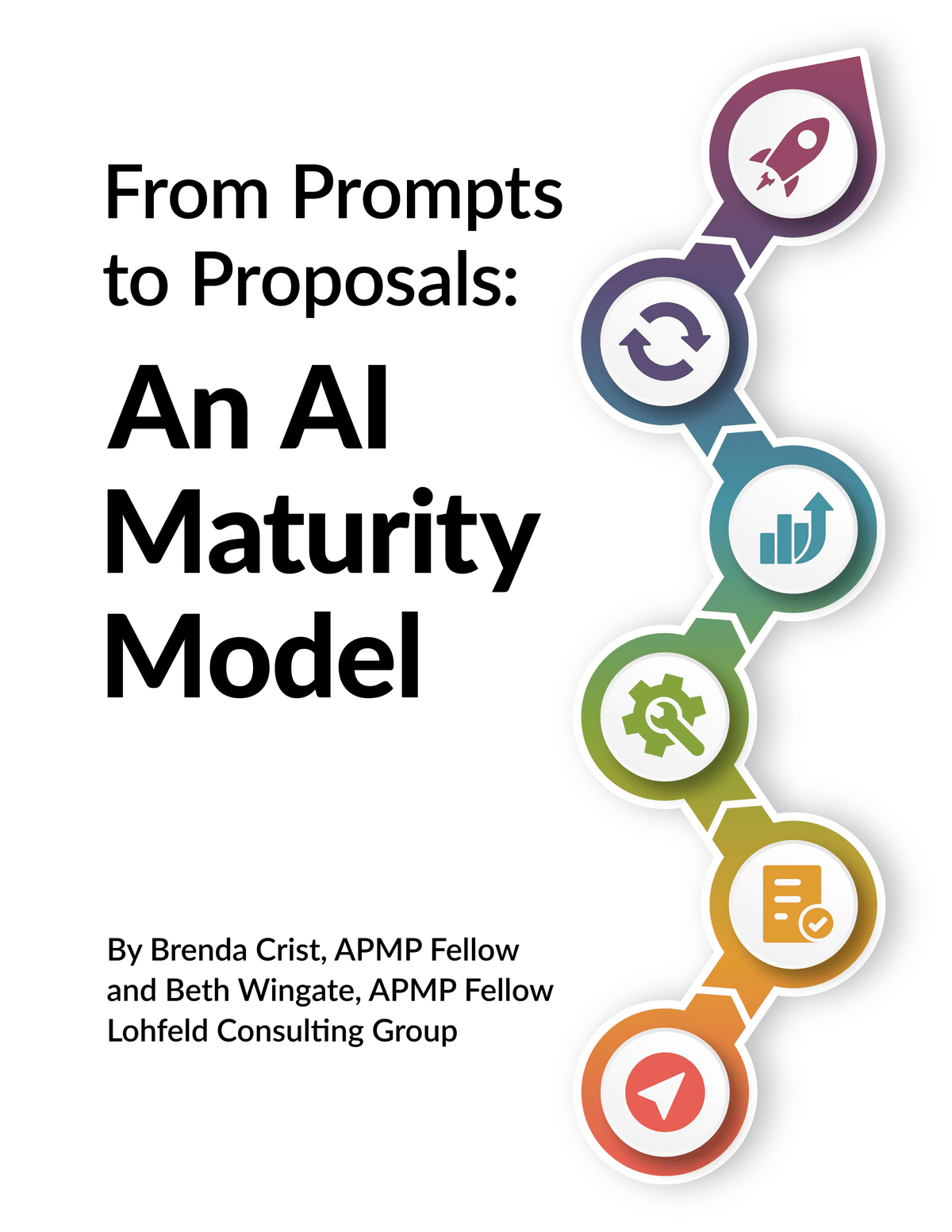
Lohfeld’s AI Maturity Model (Figure 1), detailed in our latest book, identifies time saved as a Level 1 or Level 2 measure. At these early maturity levels, individuals and teams experiment with AI, discover it speeds up specific tasks, and naturally reach for the clock as their yardstick. That instinct is not wrong. Speed is real, visible, and easy to report to leadership.
The risk, though, is stopping there. A team that only measures time saved can miss whether the faster draft is better. Speed without a quality check produces proposals that move through the pipeline quickly and still lose. The 42% figure suggests that most of the profession is measuring AI at exactly the stage the maturity model predicts: early and useful.

Compliance and Rework Signal a Maturity Shift
The second-largest group, 26%, tracks compliance or rework, and this is where the poll gets interesting. Compliance and rework metrics require teams to look past raw speed and ask a harder question: is AI producing content that survives a color review without a rewrite? That question sits closer to Level 3 and Level 4 on the maturity model, where teams introduce guardrails, structured workflows, and defined quality controls around AI.
Rework tracking also forces discipline that time-saved metrics do not. A proposal manager cannot measure rework without first defining what “compliant on the first pass” looks like, which pushes teams toward the workflow standardization the maturity model calls for at Level 3.
Win Rate and Quality Indicators Show True AI Maturity
The most encouraging numbers in the poll are also the smallest. Sixteen percent of respondents measure AI effectiveness through win rate or proposal scores, and another 16% track quality or defect indicators. Both measures require a Level 4 mindset, where AI is judged on whether it strengthens competitiveness rather than whether it saves hours.
Win rate is the hardest metric to isolate because so many variables shape a bid’s outcome beyond AI use. Teams that attempt it anyway are asking the right question: not “did AI make us faster,” but “did AI make us more competitive.” That question, more than any tool or prompt library, is what separates a mature AI proposal operation from one still finding its footing.
How to Move Your AI Effectiveness Measurement Up the Maturity Curve
Progressing past time-saved tracking doesn’t require abandoning it. Layer additional measures on top of what you already track:
- Add one compliance metric this quarter. Track first-pass compliance rates on AI-assisted sections against a defined standard.
- Tag AI-assisted proposals in your CRM. Compare their win rate against non-AI-assisted proposals over a rolling set of bids.
- Survey your reviewers. Ask color team leads whether AI-assisted sections require more or less rework than sections written without it.
- Benchmark quality, not just speed. Track evaluator-cited weaknesses on AI-assisted sections separately from strength-based content built without AI support.
The Bottom Line
Time saved is where most AI effectiveness measurement starts, and 42% of the profession is proving that pattern true. Teams tracking compliance, rework, win rate, and quality are showing what AI maturity looks like in practice. Lohfeld Consulting helps GovCon companies build the measurement discipline that turns AI experimentation into a repeatable competitive advantage, drawing on the same AI Maturity Model framework used in this analysis. Contact us to assess where your team’s AI effectiveness measurement stands today.
Continued Reading
Build on these AI effectiveness findings with these Lohfeld resources:
- How to Build an AI Learning Strategy for GovCon Proposal Teams: This companion Lohfeld poll reveals how capture and proposal teams keep up with AI advances, and why formal training remains the most underused path to AI maturity.
- How AI Acquisition Tools Are Reshaping Government Contract Bids: Federal buyers are now using AI to score proposals against evaluation criteria before a human ever reads a page, raising the stakes on the quality metrics this article discusses.
- How Solo Proposal Professionals Can Build an AI Proposal Engine: Lean teams need measurement discipline as much as large ones do. This article shows how to build the data foundation that makes compliance and quality tracking possible.
By Brenda Crist, Vice President at Lohfeld Consulting Group, MPA, CPP APMP Fellow
Lohfeld Consulting Group has proven results specializing in helping companies create winning captures and proposals. As the premier capture and proposal services consulting firm focused exclusively on government markets, we provide expert assistance to government contractors in Capture Planning and Strategy, Proposal Management and Writing, Capture and Proposal Process and Infrastructure, and Training. In the last 3 years, we’ve supported over 550 proposals winning more than $170B for our clients—including the Top 10 government contractors. Lohfeld Consulting Group is your “go-to” capture and proposal source! Start winning by contacting us at www.lohfeldconsulting.com and join us on LinkedIn, Facebook, and YouTube(TM).

Teaming friends, frenemies, and enemies—12 tips to mitigate harmful effects
Did you know that contracting officers spend up to 20% of their time mitigating disputes between teaming partners? In an informal poll we conducted on LinkedIn last month, 40% of respondents classified their teaming partners as “frenemies” on their last bid.

Subscribe to our Capture & Proposal Tips eBrief. It’s free!
Sign Up for INSIGHTS and Download your FREE book
Get a FREE copy of our latest book, From Prompts to Proposals: An AI Maturity Model, with your subscription to our Insights Newsletter.
GET YOUR FREE BOOK